
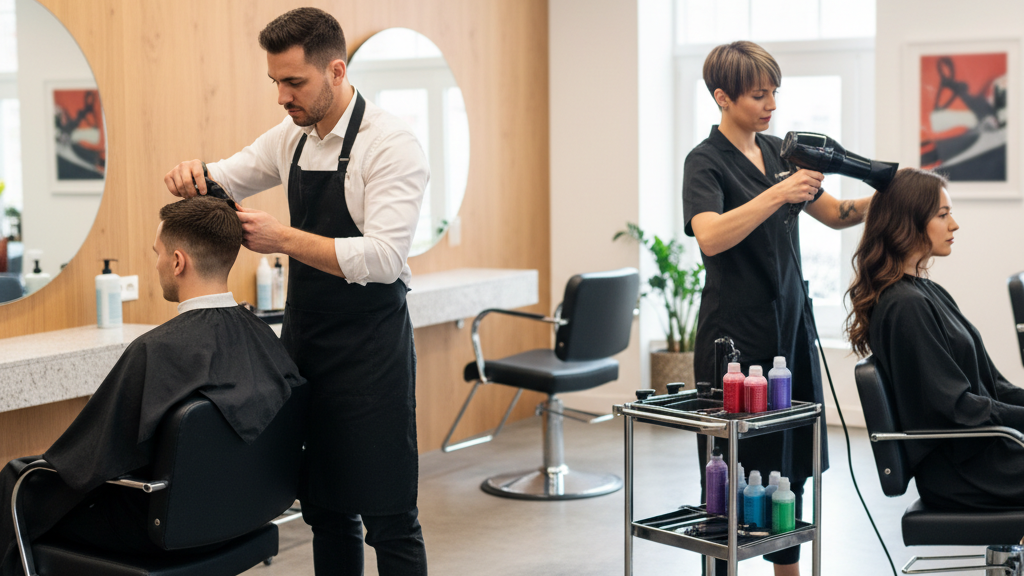
The barber vs hairdresser question comes down to focus. Both cut hair with scissors and clippers, and their training overlaps more than most people think, but a barber's work centres on short cuts, fades, beards and shaves, while a hairdresser's takes in colour, chemical treatments and longer styles for any client. If you are after a sharp fade or a tidy beard line, a barber is usually the better fit, as with the men's haircuts at Clipper Culture. For colour or a perm, you want a hairdresser.
Key Takeaways
- Barber training centres on clipper cutting, men's structures, beard design and face shaves.
- Hairdressers cover more chemistry: colour, lightening and chemical straightening are core to their qualification.
- The skills overlap, since both qualifications share cutting units, and hairdressers can choose men's electives.
- Choose by result, not by who the shop is aimed at.
- No chemical services are offered at Clipper Culture, a barber studio in Glen Alpine.
The difference between barber and hairdresser training
In Australia, the clearest way to see the split is to look at the two national qualifications. The Certificate III in Barbering includes core units in freehand clipper cutting, traditional and classic men's haircut structures, designing and maintaining beards and moustaches, and shaving heads and faces. Colouring is an elective rather than a core unit.
The Certificate III in Hairdressing flips that balance. Colouring and lightening, highlighting, bleach work and chemical straightening are all core units, and electives include long hair up-styles, braiding, extensions and chemical curling. Hairdressers can also take men's cutting, beard and shaving units, but as electives rather than requirements.
Both qualifications share the basics: designing a haircut, graduated and layered structures, over-comb techniques and identifying hair and scalp conditions. That shared ground is why a good hairdresser can give a decent men's cut, and why the line between the two jobs can blur.
Tools of the trade
Walk into each and the toolkit tells the story. A barber works mainly with clippers and trimmers, using different guard lengths and blade settings to build a fade from skin up to length. The straight razor is the other signature tool, used for crisp necklines, beard edges and the traditional hot towel shave.
A hairdresser leans on shears and styling tools: long cutting scissors for layers, thinning shears for texture, plus blow dryers, curling irons and flat irons. Add foils, mixing bowls and colour brushes for chemical work, and the kit reflects a broader menu built around longer hair and transformation.
Barber vs hairdresser services: where they split and overlap
A barber is usually the right call for:
- short, precise cuts such as a crop, crew cut or short back and sides
- fades and tapers, from a soft low taper to a skin fade
- beard trims, shaping and a line up
- a cut throat or hot towel shave
A hairdresser is usually the right call for:
- colour, highlights, balayage or colour correction
- perms, chemical straightening or relaxing
- long layered styles, up-styles, braids and extensions
- event styling for longer hair
Hairdressers also offer deep conditioning, keratin smoothing and other restorative treatments, which sit outside a barber's work.
The overlap is real. The Australian Government's Your Career site describes hairdressers as cutting hair with scissors, clippers and razors, and lists shaving faces and trimming beards among their day-to-day tasks. So the difference is mostly emphasis and practice: a barber spends most of the working week on the services in the first list.
When you're in my chair, you have my full attention, one barber, one client, no rush and no noise.
After a fade, a beard tidy or a shave? Book a time with Jonah, or call to ask first.
Barbershop or salon: the feel of the room
The setting tends to follow the services. Salons are often built for longer appointments, with basins for washing, several styling stations and space for colour to process. Many barbershops run on short, frequent visits and a steady stream of walk-ins.
Clipper Culture sits apart from both. It is a private, appointment-only barber studio in Glen Alpine where Jonah Ataalla, the owner and only barber, sees one client at a time, with no queue and no waiting room. The menu is strictly barbering: men's standard haircuts, fades, high school fades, kids cuts, beard trim and line up, and the cut throat shave. There are no perms, colouring or chemical services, which is common for barbers: see barbers and perms.
How to choose for your next cut
Start with the result, not the sign above the door. If the finished look depends on a sharp blend, a defined neckline or a shaped beard, book a barber who does that work every day, such as skin fades and tapers or a beard trim and line up. A barber's daily work also covers the finer points of men's hair: a sharp side part, a cut that suits a receding hairline, or a beard blended into the haircut. If it depends on colour, chemical texture or a lot of length, book a hairdresser.
For a mid-length men's style that is mostly scissor work, either can do a good job, so choose the person whose existing work looks like what you want. Photos of their recent cuts tell you more than any job title.
Frequently Asked Questions
Can a barber cut women's hair?
A barber can cut any hair, and short styles such as pixie cuts, undercuts or clipper work often suit a barber's skills well. For longer layered styles, colour or chemical treatments, a hairdresser is better placed, since that is where their training and daily practice sit. If you want a short, clipper-based cut, ask the barber directly whether it is something they do regularly.
Do hairdressers cut men's hair well?
Many do. Where a dedicated barber usually has the edge is short clipper work, because of volume of practice: someone doing fades and line ups all week builds a feel for blends, necklines and beard edges that is hard to match with occasional clipper work.
Is a barber cheaper than a hairdresser?
It depends on the business and the service, so compare total prices for the exact cut you want. Colour and chemical treatments are separate services with their own prices, so a cut and colour is not comparable with a cut alone. Clipper Culture's current prices are set per service, so you know the cost before you book.
Did barbers once do more than cut hair?
Yes. In earlier centuries the barber's trade covered a much wider range of work than haircuts and shaves. The job narrowed over time to the grooming services barbers are known for today, as the history of medieval barbers shows.
Should I see a barber or hairdresser for curly hair?
Either can cut curly hair well if they have experience with it. A barber is a good choice for curly hair kept short on the sides, such as a curly top with a taper or fade, or a high-top. A hairdresser may suit longer curls or anyone wanting chemical changes to the curl itself. Ask to see examples of curly cuts they have done.
Choosing the right chair
Barber vs hairdresser is not a contest, and neither profession is better in general. They are trained for different emphases, and the right one is the one who spends their days doing the cut you want.
If that is a fade, a beard or a short men's cut, meet Jonah, the barber holding the clippers.
To book a barber cut, beard trim or shave, call Clipper Culture on 0415 990 995 or choose a time online.
Book the chair.
Private, timed appointments in Glen Alpine, NSW — after-hours and weekends welcome.